Why does enterprise GenAI perform well on some tasks but fail on others of seemingly similar difficulty?
In a new paper, I suggest interpreting current enterprise GenAI systems as a form of Generalized Search Intelligence (GSI).
This interpretation considers the complete system: the language model, learned representations, retrieval, external tools, the surrounding harness, and the human knowledge required to make the system useful.
Much of the information available to these systems consists of the final products of human and organizational decisions. It often omits how those decisions were made, which alternatives were rejected, and the constraints and incentives that shaped the outcome.
Learning to retrieve and reproduce patterns of past decisions does not necessarily correspond to an ability to make those decisions.
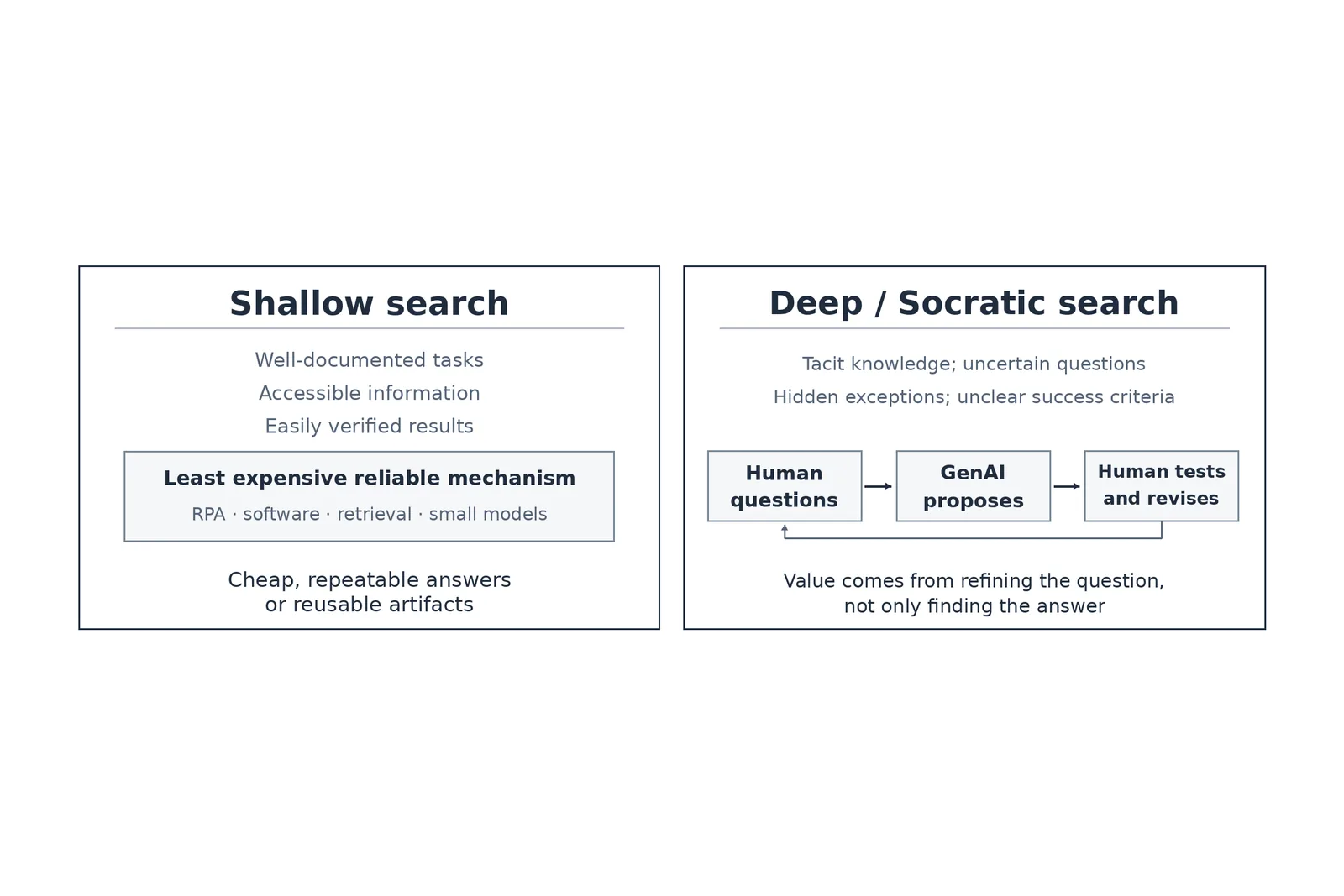
This distinction has practical consequences. For well-defined tasks, conventional software and simpler mechanisms may be more reliable and economical. For less-defined problems, GenAI can serve as a Socratic engine, helping people refine questions, expose contradictions, and discover missing process knowledge.
The Research Brief develops the GSI interpretation, examines the evidence of uneven enterprise performance, and proposes heuristics for deciding where GenAI is useful and where human knowledge and judgment remain essential.