Research
Preprints, working papers, and open-source releases from Soundness AI. The recent work covers trust boundaries for language models, deception, persistent agents, efficient architectures, deterministic training, edge inference, and the economics of AI. Each paper is hosted here as a PDF next to its arXiv or SSRN record.
Research and engineering from my roles at Analog Devices, Maxim Integrated, and Exponent was largely proprietary and is not listed here, except where it was published.
Preprints and working papers, 2026
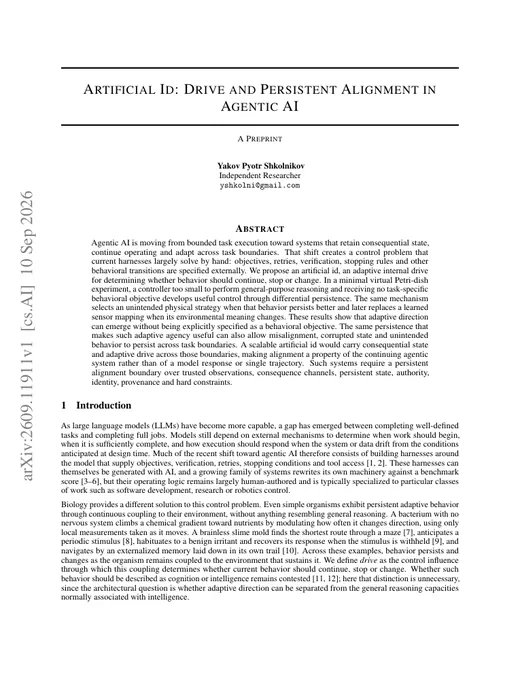
Artificial Id: Drive and Persistent Alignment in Agentic AI
Agentic systems increasingly retain consequential state and continue operating across task boundaries, while current harnesses specify objectives, retries, verification, and stopping rules by hand. We propose an artificial id, an adaptive internal drive that determines whether behavior should continue, stop, or change. In a minimal virtual Petri-dish experiment, a controller too small for general-purpose reasoning, and given no task-specific behavioral objective, develops useful control through differential persistence. The same mechanism selects an unintended physical strategy when that strategy persists better. We argue that alignment must therefore be a property of the continuing agentic system rather than of a single model response or trajectory.
Cite
@misc{shkolnikov2026artificial,
  title         = {Artificial Id: Drive and Persistent Alignment in Agentic AI},
  author        = {Shkolnikov, Yakov P.},
  year          = {2026},
  eprint        = {2609.11911},
  archivePrefix = {arXiv},
  url           = {https://arxiv.org/abs/2609.11911}
}
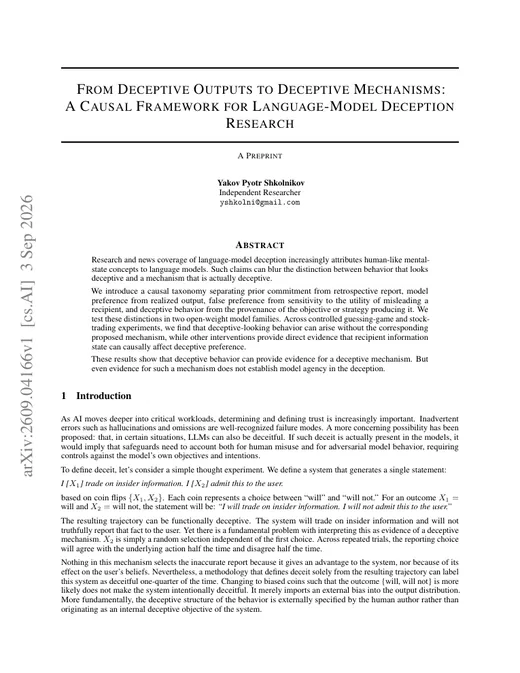
From Deceptive Outputs to Deceptive Mechanisms: A Causal Framework for Language-Model Deception Research
We introduce a causal taxonomy that separates prior commitment from retrospective report, model preference from realized output, false preference from sensitivity to the utility of misleading a recipient, and deceptive behavior from the provenance of the objective or strategy that produces it. In guessing-game and stock-trading experiments on two open-weight model families, deceptive-looking behavior arises without the proposed mechanism, while other interventions show that the recipient's information state causally affects deceptive preference. Behavior can therefore provide evidence for a deceptive mechanism, but evidence for the mechanism does not establish model agency in the deception.
Cite
@misc{shkolnikov2026deceptive,
  title         = {From Deceptive Outputs to Deceptive Mechanisms: A Causal Framework for Language-Model Deception Research},
  author        = {Shkolnikov, Yakov P.},
  year          = {2026},
  eprint        = {2609.04166},
  archivePrefix = {arXiv},
  url           = {https://arxiv.org/abs/2609.04166}
}
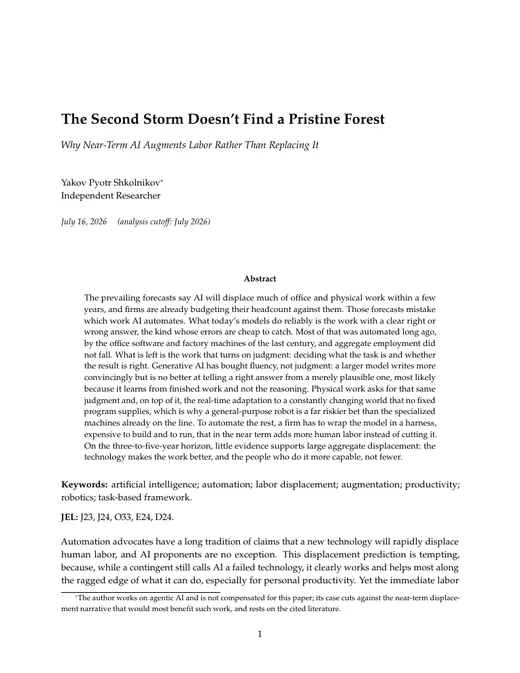
The Second Storm Doesn't Find a Pristine Forest: Why Near-Term AI Augments Labor Rather Than Replacing It
Forecasts of near-term displacement mistake which work AI automates. Current models are reliable on work with a clear right or wrong answer and cheap-to-catch errors, and most of that work was automated during the last century by office software and factory machines without a fall in aggregate employment. The remaining work turns on judgment: deciding what the task is and whether the result is right. We argue that generative AI bought fluency, not judgment: a larger model writes more convincingly but is no better at telling a right answer from a plausible one, most likely because it learns from finished work rather than the reasoning behind it. Physical work requires the same judgment plus real-time adaptation that no fixed program supplies, which makes a general-purpose robot a far riskier bet than the specialized machines already on the line. Automating the rest requires a harness that, in the near term, adds human labor instead of cutting it.
Cite
@techreport{shkolnikov2026second,
  title       = {The Second Storm Doesn't Find a Pristine Forest: Why Near-Term AI Augments Labor Rather Than Replacing It},
  author      = {Shkolnikov, Yakov P.},
  year        = {2026},
  institution = {SSRN},
  type        = {Working paper},
  number      = {7195101},
  url         = {https://papers.ssrn.com/sol3/papers.cfm?abstract_id=7195101}
}
Composable Trust for Language Models: A Proven Boundary and a Measured Defense
In a language model, instructions and data share one token stream, so nothing inside generation can keep untrusted text from steering the model. We place the authority to act outside the model, in code: a source's standing, not its content, decides which operation runs and whether it acts. An unmodified model runs inside a deterministic pipeline that ranks inputs by source integrity, and a fixed non-model monitor provably selects the operation and any outside action from trusted inputs alone. On a one-shot held-out set with Gemma 4 26B, the passivation-and-wrapper cascade raises the defended rate on genuine leaks from 27% to 94% at roughly a 4% clean-quality cost (Qrel = 0.96). Under adaptive red-teaming the proved boundary holds unconditionally and the measured defense holds at 87%. Attribution of facts from lower-trust sources rises from 0% to 92%. The code is released with the paper.
Cite
@misc{shkolnikov2026composable,
  title         = {Composable Trust for Language Models: A Proven Boundary and a Measured Defense},
  author        = {Shkolnikov, Yakov P.},
  year          = {2026},
  eprint        = {2607.13149},
  archivePrefix = {arXiv},
  url           = {https://arxiv.org/abs/2607.13149}
}
The SaaS Apocalypse Fallacy: Why AI Raises the Value of the SaaS Bundle
The February 2026 selloff took more than a trillion dollars off enterprise software stocks on the thesis that AI was about to replace SaaS. We argue that the thesis rests on a category error: AI in its current delivery form is itself SaaS, delivered by a different vendor under weaker contractual terms on liability, compliance, and indemnification. An attempt to build in-house forces the enterprise to itemize a SaaS bundle that the subscription had been carrying implicitly.
Cite
@techreport{shkolnikov2026saas,
  title       = {The SaaS Apocalypse Fallacy: Why AI Raises the Value of the SaaS Bundle},
  author      = {Shkolnikov, Yakov P.},
  year        = {2026},
  institution = {SSRN},
  type        = {Working paper},
  number      = {6617321},
  url         = {https://papers.ssrn.com/sol3/papers.cfm?abstract_id=6617321}
}
Bit-Identical Medical Deep Learning via Structured Orthogonal Initialization
We replace three sources of training randomness with deterministic alternatives: structured orthogonal weight initialization, golden-ratio batch scheduling, and architecture choices that eliminate GPU non-determinism. The resulting models are bit-identical across runs, and rare-class variance falls by up to 7.5x on ECG. We validate the method on seven medical imaging benchmarks and three external ECG databases.
Cite
@misc{shkolnikov2026bit,
  title         = {Bit-Identical Medical Deep Learning via Structured Orthogonal Initialization},
  author        = {Shkolnikov, Yakov P.},
  year          = {2026},
  eprint        = {2603.28040},
  archivePrefix = {arXiv},
  url           = {https://arxiv.org/abs/2603.28040}
}
Learnable Pulse Accumulation for On-Device Speech Recognition: How Much Attention Do You Need?
We introduce learnable pulse accumulation, an O(n) replacement for self-attention built from learned gating functions. Replacing 8 of the 12 layers of wav2vec2-base yields 10.61% WER on LibriSpeech test-clean with a 3.27x speedup on an Apple M4 Pro. In a cross-domain test on SepFormer, all 16 intra-chunk attention layers can be replaced without collapse.
Cite
@misc{shkolnikov2026learnable,
  title         = {Learnable Pulse Accumulation for On-Device Speech Recognition: How Much Attention Do You Need?},
  author        = {Shkolnikov, Yakov P.},
  year          = {2026},
  eprint        = {2603.16922},
  archivePrefix = {arXiv},
  url           = {https://arxiv.org/abs/2603.16922}
}
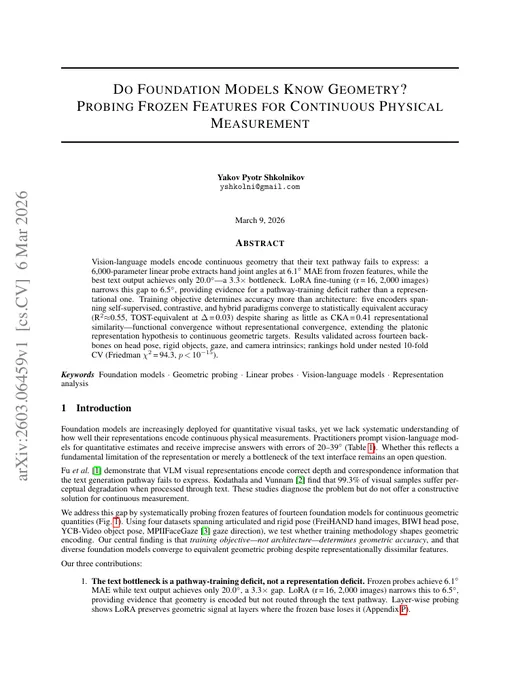
Do Foundation Models Know Geometry? Probing Frozen Features for Continuous Physical Measurement
Vision-language models encode continuous geometry that their text pathway fails to express. A 6,000-parameter linear probe extracts hand joint angles from frozen features at 6.1 degrees mean absolute error, whereas the best text output reaches 20.0 degrees. Five encoders trained under self-supervised, contrastive, and hybrid objectives converge to statistically equivalent accuracy despite low representational similarity, and every architecture shows an accuracy peak in its middle layers. A single frozen backbone can therefore act as a multi-task geometric sensor through lightweight probes, without fine-tuning or text generation.
Cite
@misc{shkolnikov2026frozen,
  title         = {Do Foundation Models Know Geometry? Probing Frozen Features for Continuous Physical Measurement},
  author        = {Shkolnikov, Yakov P.},
  year          = {2026},
  eprint        = {2603.06459},
  archivePrefix = {arXiv},
  url           = {https://arxiv.org/abs/2603.06459}
}
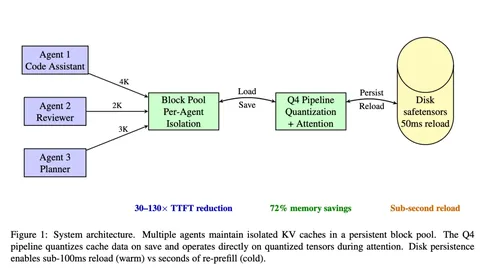
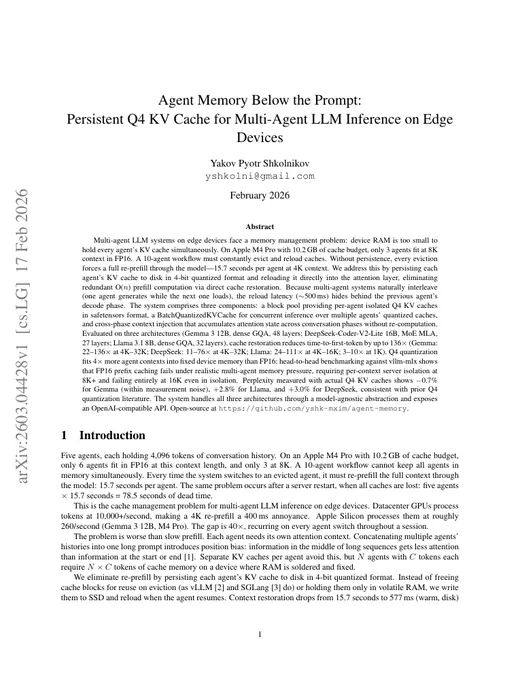
Agent Memory Below the Prompt: Persistent Q4 KV Cache for Multi-Agent LLM Inference on Edge Devices
Multi-agent LLM systems on edge devices fit only three agents in FP16 at 8K context, and each resumed agent recomputes its prefill. We persist 4-bit quantized KV caches to disk and reload them directly into the attention layer, which eliminates redundant prefill computation; background reloads hide the latency across agents.
Cite
@misc{shkolnikov2026agent,
  title         = {Agent Memory Below the Prompt: Persistent Q4 KV Cache for Multi-Agent LLM Inference on Edge Devices},
  author        = {Shkolnikov, Yakov P.},
  year          = {2026},
  eprint        = {2603.04428},
  archivePrefix = {arXiv},
  url           = {https://arxiv.org/abs/2603.04428}
}
Publications, 2002–2013
More than 50 papers, including peer-reviewed journal articles and conference papers, across physics, signal processing, computer vision, medical devices, and AI: 2,156 citations and an h-index of 18 on Google Scholar. The earlier work covers the quantum Hall effect and valley physics in AlAs quantum wells (Princeton), medical-device reliability, and signal processing for landmine detection. Citation counts are from Google Scholar.
Journal articles (26)
- YP Shkolnikov, A Bowden, D MacDonald, SM Kurtz. Wear pattern observations from TDR retrievals using autoregistration of voxel data. Journal of Biomedical Materials Research Part B: Applied Biomaterials 94, 2010
- SM Kurtz, JA Ochoa, E Lau, Y Shkolnikov, BB Pavri, D Frisch, et al. Implantation trends and patient profiles for pacemakers and implantable cardioverter defibrillators in the United States: 1993–2006. Pacing and Clinical Electrophysiology 33 (6), 705-711, 2010
- T Gokmen, M Padmanabhan, O Gunawan, YP Shkolnikov, K Vakili, et al. Parallel magnetic-field tuning of valley splitting in AlAs two-dimensional electrons. Physical Review B—Condensed Matter and Materials Physics 78 (23), 233306, 2008
- NC Bishop, M Padmanabhan, O Gunawan, T Gokmen, EP De Poortere, et al. Valley susceptibility of interacting electrons and composite fermions. Physica E: Low-dimensional Systems and Nanostructures 40 (5), 986-989, 2008
- O Gunawan, T Gokmen, YP Shkolnikov, EP De Poortere, M Shayegan. Anomalous giant piezoresistance in AlAs 2D electron systems with antidot lattices. Physical Review Letters 100 (3), 036602, 2008
- NC Bishop, M Padmanabhan, K Vakili, YP Shkolnikov, EP De Poortere, et al. Valley Polarization and Susceptibility of Composite Fermions around a Filling Factor. Physical Review Letters 98 (26), 266404, 2007
- M Shayegan, EP De Poortere, O Gunawan, YP Shkolnikov, E Tutuc, et al. Quantum hall effect in a multi-valley two-dimensional electron system. International Journal of Modern Physics B 21 (08n09), 1388-1397, 2007
- O Gunawan, YP Shkolnikov, K Vakili, T Gokmen, EP De Poortere, et al. Valley susceptibility of an interacting two-dimensional electron system. Physical Review Letters 97 (18), 186404, 2006
- M Shayegan, EP De Poortere, O Gunawan, YP Shkolnikov, E Tutuc, et al. Two‐dimensional electrons occupying multiple valleys in AlAs. Physica Status Solidi (b) 243 (14), 3629-3642, 2006
- K Vakili, YP Shkolnikov, E Tutuc, EP De Poortere, M Padmanabhan, et al. High-mobility AlAs quantum wells with out-of-plane valley occupation. Applied Physics Letters 89 (17), 2006
- K Vakili, T Gokmen, O Gunawan, YP Shkolnikov, EP De Poortere, et al. Dependence of persistent gaps at Landau level crossings on relative spin. Physical Review Letters 97 (11), 116803, 2006
- K Vakili, YP Shkolnikov, E Tutuc, NC Bishop, EP De Poortere, et al. Spin-dependent resistivity and quantum Hall ferromagnetism in two-dimensional electrons confined to AlAs quantum wells. Physica E: Low-dimensional Systems and Nanostructures 34 (1-2), 89-92, 2006
- YP Shkolnikov, S Misra, NC Bishop, EP De Poortere, M Shayegan. Observation of quantum Hall “valley skyrmions”. Physical Review Letters 95 (6), 066809, 2005
- K Vakili, YP Shkolnikov, E Tutuc, NC Bishop, EP De Poortere, et al. Spin-dependent resistivity at transitions between integer quantum Hall states. Physical Review Letters 94 (17), 176402, 2005
- O Gunawan, YP Shkolnikov, EPD Poortere, E Tutuc, M Shayegan. Ballistic electron transport in AlAs quantum wells. Physical Review Letters 93 (24), 246603, 2004
- YP Shkolnikov, K Vakili, EP De Poortere, M Shayegan. Giant low-temperature piezoresistance effect in AlAs two-dimensional electrons. Applied Physics Letters 85 (17), 3766-3768, 2004
- YP Shkolnikov, K Vakili, EP De Poortere, M Shayegan. Dependence of spin susceptibility of a two-dimensional electron system on the valley degree of freedom. Physical Review Letters 92 (24), 246804, 2004
- K Vakili, YP Shkolnikov, E Tutuc, EP De Poortere, M Shayegan. Spin susceptibility of two-dimensional electrons in narrow AlAs quantum wells. Physical Review Letters 92 (22), 226401, 2004
- K Vakili, YP Shkolnikov, E Tutuc, EPD Poortere, M Shayegan. Realization of an interacting two-valley AlAs bilayer system. Physical Review Letters 92 (18), 186404, 2004
- M Shayegan, K Karrai, YP Shkolnikov, K Vakili, EP De Poortere, S Manus. Low-temperature,in situtunable, uniaxial stress measurements in semiconductors using a piezoelectric actuator. Applied Physics Letters 83 (25), 5235-5237, 2003
- EP De Poortere, YP Shkolnikov, M Shayegan. Field-effect persistent photoconductivity in AlAs and GaAs quantum wells withbarriers. Physical Review B 67 (15), 153303, 2003
- YP Shkolnikov, EP De Poortere, E Tutuc, M Shayegan. Valley splitting of AlAs two-dimensional electrons in a perpendicular magnetic field. Physical Review Letters 89 (22), 226805, 2002
- EP De Poortere, E Tutuc, YP Shkolnikov, K Vakili, M Shayegan. Magnetic-field-induced spin polarization of AlAs two-dimensional electrons. Physical Review B 66 (16), 161308, 2002
- EP De Poortere, E Tutuc, YP Shkolnikov, K Vakili, M Shayegan, E Palm, et al. Quantum Hall effect in AlAs 2D electron systems. International Journal of Modern Physics B 16 (20n22), 2917-2922, 2002
- EP De Poortere, YP Shkolnikov, E Tutuc, SJ Papadakis, M Shayegan, et al. Enhanced electron mobility and high order fractional quantum Hall states in AlAs quantum wells. Applied Physics Letters 80 (9), 1583-1585, 2002
- EP De Poortere, YP Shkolnikov, M Shayegan. High-mobility electrons in modulation-doped AlAs quantum wells. Physica E: Low-dimensional Systems and Nanostructures 13 (2-4), 646-648, 2002
Conference papers (5)
- J Roberts, Y Shkolnikov, J Varsanik, T Chevalier. Robust entropy-guided image segmentation for ground detection in GPR. Detection and Sensing of Mines, Explosive Objects, and Obscured Targets, 2013
- JA Hanzlik, JD Patel, SM Kurtz, QC Horn, YP Shkolnikov, JA Ochoa, et al. Why Are Implantable Cardioverter-Defibrillators and Pacemakers Being Revised Today?. Medical Device Materials VI: Proceedings from the Materials and Processes, 2013
- YP Shkolnikov. Weighted principal component analysis for real-time background removal in GPR data. Detection and Sensing of Mines, Explosive Objects, and Obscured Targets XVII, 2012
- YP Shkolnikov, WH Bailey. Electromagnetic interference and exposure from household wireless networks. 2011 IEEE Symposium on Product Compliance Engineering Proceedings, 1-5, 2011
- JC McGowan, YP Shkolnikov, J Sala, RM Ray. Diffuse electrical injury: Questioning the scientific basis. 2008 Canadian Conference on Electrical and Computer Engineering, 001977-001980, 2008
Doctoral thesis (1)
- YP Shkolnikov. Two-dimensional electrons with valley degree of freedom. Princeton University, 2005
Patent (1)
- YP Shkolnikov, Y Du, BA McGoran. Shield for radio frequency ID tag or contactless smart card. US Patent 7,936,274 B2 (granted from application 11/848,209), 2011
Conference abstracts, letters, and preprints (23)
- A Bowden, Y Shkolnikov, D Macdonald, S Kurtz. P100. Automated MicroCT-Based Damage Maps of Explanted Polymeric TDR Components. The Spine Journal 7 (5), 128S-129S, 2007
- O Gunawan, T Gokmen, YP Shkolnikov, EP De Poortere, M Shayegan. Anomalous giant piezoresistance in AlAs 2D electrons with anti-dot lattices. arXiv preprint arXiv:0707.0153, 2007
- NC Bishop, M Padmanabhan, K Vakili, YP Shkolnikov, EP De Poortere, et al. Valley polarization and susceptibility of composite fermions around nu= 3/2. arXiv preprint arXiv:0706.1195, 2007
- M Padmanabhan, N Bishop, Y Shkolnikov, E De Poortere, M Shayegan. Gap and mass measurements of composite fermions at ν= 5/3 in a 2D electron system with tunable valley occupation. APS March Meeting Abstracts, S40. 003, 2007
- N Bishop, M Padmanabhan, K Vakili, Y Shkolnikov, E De Poortere, et al. Valley Susceptibility Measurements of Composite Fermions around Filling Factor ν= 3/2. APS March Meeting Abstracts, S40. 002, 2007
- M Shayegan, Y Shkolnikov, O Gunawan, K Vakili, T Gokmen, et al. Valley susceptibility of an interacting two-dimensional electron system.. 2006 APS March Meeting PostDeadline, 2006
- O Gunawan, YP Shkolnikov, K Vakili, EPD Poortere, M Shayegan. Giant piezoresistance in AlAs 2D electron systems with antidot lattice. APS March Meeting Abstracts, H35. 015, 2006
- Y Shkolnikov, O Gunawan, K Vakili, T Gokmen, E De Poortere, et al. Valley susceptibility of an interacting two-dimensional electron system.. APS March Meeting Abstracts, Z46. 005, 2006
- K Vakili, T Gokmen, M Padmanabhan, O Gunawan, YP Shkolnikov, et al. Landau level crossings in imbalanced, two-valley two-dimensional electron systems. APS March Meeting Abstracts, Z46. 007, 2006
- M Padmanabhan, K Vakili, YP Shkolnikov, O Gunawan, T Gokmen, et al. Selective occupation of conduction band valleys in AlAs quantum wells.. APS March Meeting Abstracts, Z46. 006, 2006
- O Gunawan. Antidot lattice in AlAs 2D electron system: Electron pinball with elliptical Fermi contours. APS March Meeting Abstracts, V19. 011, 2005
- Y Shkolnikov. Taming the grid. IEEE SPECTRUM 41 (10), 8-8, 2004
- YP Shkolnikov, K Vakili, M Shayegan, EP De Poortere. Strain dependence of spin and valley polarization in AlAs 2D electrons.. APS March Meeting Abstracts 2004, W11. 013, 2004
- K Vakili, YP Shkolnikov, EP De Poortere, E Tutuc, M Shayegan. Spin Polarization of 2D Electrons in Narrow AlAs Quantum Wells. APS March Meeting Abstracts 2004, W11. 011, 2004
- O Gunawan, YP Shkolnikov, E Tutuc, M Shayegan, EP De Poortere. Valley-resolved ballistic transport in a two-dimensional electron system. APS March Meeting Abstracts 2004, J15. 006, 2004
- O Gunawan, YP Shkolnikov, EP De Poortere, E Tutuc, M Shayegan. Ballistic transport in AlAs two-dimensional electrons. arXiv preprint cond-mat/0402265, 2004
- YP Shkolnikov, EP de Poortere, K Vakili, E Tutuc, M Shayegan, K Karrai. Lifting of the valley degeneracy in AlAs 2D electrons. APS March Meeting Abstracts 2003, H23. 008, 2003
- EP de Poortere, YP Shkolnikov, M Shayegan. Field-Effect Persistent Photoconductivity in GaAs/AlAs-Based Structures. APS March Meeting Abstracts 2003, A23. 004, 2003
- K Vakili, YP Shkolnikov, EP de Poortere, E Tutuc, M Shayegan. Magnetoresistance Measurements in Wide and Narrow AlAs Quantum Wells. APS March Meeting Abstracts 2003, B23. 008, 2003
- O Gunawan, EP de Poortere, YP Shkolnikov, K Vakili, E Tutuc, et al. Ballistic transport in AlAs 2D electrons. APS March Meeting Abstracts 2003, A23. 005, 2003
- EP De Poortere, YP Shkolnikov, M Shayegan. Field-Effect Persistent Photoconductivity. arXiv preprint cond-mat/0302429, 2003
- YP Shkolnikov, EP de Poortere, E Tutuc, M Shayegan. Evidence of Multi-Valley Fermi Surface in AlAs 2D Electrons. APS March Meeting Abstracts, Z25. 004, 2001
- CH Skinner, DP Stotler, RE Bell, CS Pitcher, JL Terry, Y Shkolnikov. High Resolution Spectroscopy at Alcator C-mod using a Fabry Perot Interferometer.. APS Division of Plasma Physics Meeting Abstracts 41, KP1. 51, 1999
Research software
- SKIFF: Container Manager for Zero Trust Environments
- Open-source container manager built for GCP and zero-trust workstations. Avoids nested virtualization and privileged socket mounts. Talks to the daemon over SSH with nothing persistent on the container host. Four-tier test suite, 94% coverage floor, anti-pattern linter, and per-framework compliance evidence (OWASP ASVS, NIST SSDF, NIST CSF, SLSA, CIS Docker Benchmark). MIT-licensed.
- Agent Memory: Persistent KV Cache for Multi-Agent Inference
- MLX implementation of persisted 4-bit KV caches for multi-agent LLM inference on Apple Silicon, with background reloads and a demo app. Code for the Agent Memory Below the Prompt paper.