
One of the major debates in AI right now is what role it plays in the modern workplace. Is it a replacement for human labor, commoditizing the work of white collar, service and blue collar employees alike? Or is it a failed technology with no benefit other than letting companies project growth where there is none?
In both cases I believe the identification of what this technology is is faulty. Like every other technology of the last hundred years, AI is a tool to be used by people, in a workplace that has already been dramatically transformed by previous waves of technology.
Which work AI actually automates
In the early days after the release of ChatGPT, the prevailing view was that AI was about to produce a dramatic jump in the speed of product development, and a large increase in demand across all the different portions of the economy. But as the reality of failed transitions from the prototype to a product, and from the lab to the factory floor and services, hit, the conversation changed into a discussion of how AI can benefit company economics by reducing the cost of labor. My paper argues that the thesis predicting the labor reduction is weaker than the capability thesis of AI.
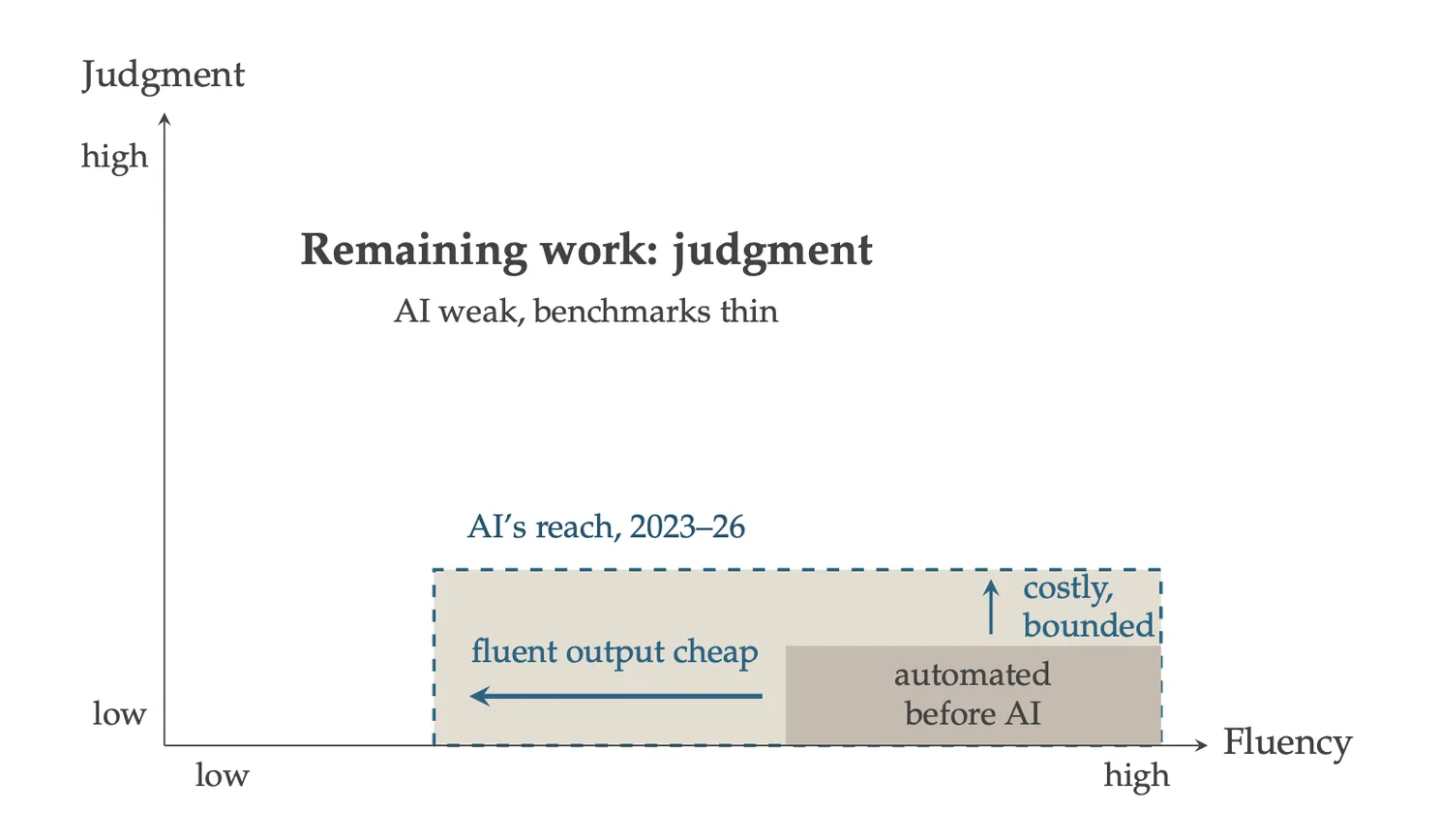
GenAI is strongest in fluency, that is, in completing highly repetitive work with very well specified and easy to check completion requirements. But it is weakest in judgment: defining what the task to be done is, and what is deemed high quality work.
But the highly repetitive, easy to check work has long ago been automated away by the office software and factory machines of the last century. And what remains can colloquially be described as "just figure it out." Critically, that automation transition did not displace human labor, even if some workers were impacted, by more than automation alone: the outsourcing and offshoring waves hit at the same time.
Applied correctly, GenAI is very valuable
Generative AI is very valuable, especially when applied to tasks that were difficult to automate before because of the cost of setting up the automation. That is, tasks with enough variability that deterministic processes are expensive due to a large number of ambiguous edge cases, but where the work does not require a human to verify completion.
In such applications the gains showed up very quickly. Support agents resolved 14% more issues an hour. Professionals wrote 40% faster on short writing tasks. Developers finished a defined coding task 55.8% faster.
It also helps dramatically with a specific type of research. One where the work is retrieval of papers, easy to check for completion; boilerplate code writing, easy to check by execution and by seeing the display; and searching and combining a large number of results, such as in mathematical or cryptographic proofs.
Any company looking for a quick win would benefit from triaging the work their organization does that follows this pattern, as that is where the quickest transition from an idea to a working solution is likely to show up.
Applied incorrectly, GenAI is a burden
When a task is poorly defined, the fluency of GenAI becomes a burden. By producing a large volume of under-defined work that is difficult to verify, AI acts as a saboteur, draining resources from the team it is supposed to help.
The misleading hope that this is not the case comes from software development. Harnesses for software were developed by experts, over two to three years, with a large amount of spend, and by exploiting the fact that the subject matter experts were themselves the developers of the harnesses. That dramatically, and very expensively, decreased the judgment needed to develop software. And even there, the work was relying on years of compilers, formal verification, and large special and general purpose libraries.
Any organization trying to repeat this in other areas where judgment is a bottleneck will face the long development time, and consequently the increase in labor demand and cost implied by the magnitude of the work. And all of this with additional coordination required between non-software subject matter experts and the software development team.
Humanoid robotics: judgment with a real-time component
Humanoid robotics has a much more difficult and narrower space to operate in. Where the environment can be controlled and the tasks are repetitive, there is already ample and cheap competition from appliances, industrial robotics, and warehouse management systems. The remaining, open-world domain requires not only the judgment, but also real-time adaptation.
All of this without being able to run agentic loops: falling down and getting up is quite a bit more damaging than editing a variable in code that does not compile.
And the financial rewards are constrained by competition from low-cost human physical labor and from task-specific robotics. It is the latter category that can scale faster with AI. That is still a pressure on labor, but it is in applications where labor has already been under pressure for a hundred years.
The winning robotic solution is the specialized one. The built world was made for people using tools, so the machine that pays off is the one that becomes the tool, not the one that mimics the person.
Leaders should embrace the tools and keep the people
The picture on AI is unlikely to change significantly enough in five years to make major labor displacement a likely outcome. A leader who identifies where fluency is needed more than judgment, and augments human labor with AI in those areas, is likely to come out ahead of leaders who are searching for a way to displace humans with generative AI no matter how appropriate the technology is for a specific task.
It also creates an opportunity for developing technology to reduce the friction of human and AI collaboration, and of collaboration between humans using AI. And as a disclosure, this is the focus of the work my independent research lab is doing.
Taking a bet and watching closely
The overall picture, based on all the evidence through the end of July 2026, is that companies which laid off people in anticipation of AI productivity gains have made the wrong choice. These companies are likely, in the near future, to begin hiring back and rebuilding the organizational capabilities wounded by this overreaction. As an early signal of this, last week the Wall Street Journal reported that companies are hiring again after a year of holding back, because the costs and limits of AI mean they need people to work alongside it.
Over the next few months I will continue monitoring the literature, and plan to publish a follow up article in September with newly added evidence and any corrections, while expanding the section on robotics that the current version shortchanged.
My day job is building agentic AI, which is greatly helped by the use of AI to increase my fluency in creating prototypes and product definitions. My research and development work likewise benefits from the use of AI. I am not a pessimist who thinks AI has no use in work, but I am also aware that close to 100% of the time, that work has to be closely guided and guarded by my intervention.
The Second Storm Doesn't Find a Pristine Forest: Why Near-Term AI Augments Labor Rather Than Replacing It. Yakov Shkolnikov