Early in my career, I used to make light of simple principles for guiding business decisions. When I got a PhD, I tended to assume that the world of business was simple enough that somebody with an advanced education should have little difficulty identifying what matters and what doesn't. Simple rules seemed like something for people who weren't particularly attuned to the real complexities of technology and the marketplace.
Experience proved that assumption wrong. As I managed different teams, from PhDs to people without degrees, it became clear to me that when decisions piled up, and their risks extended further into the future, I needed a simple framework for making decisions rather than treating every situation as a one-off.
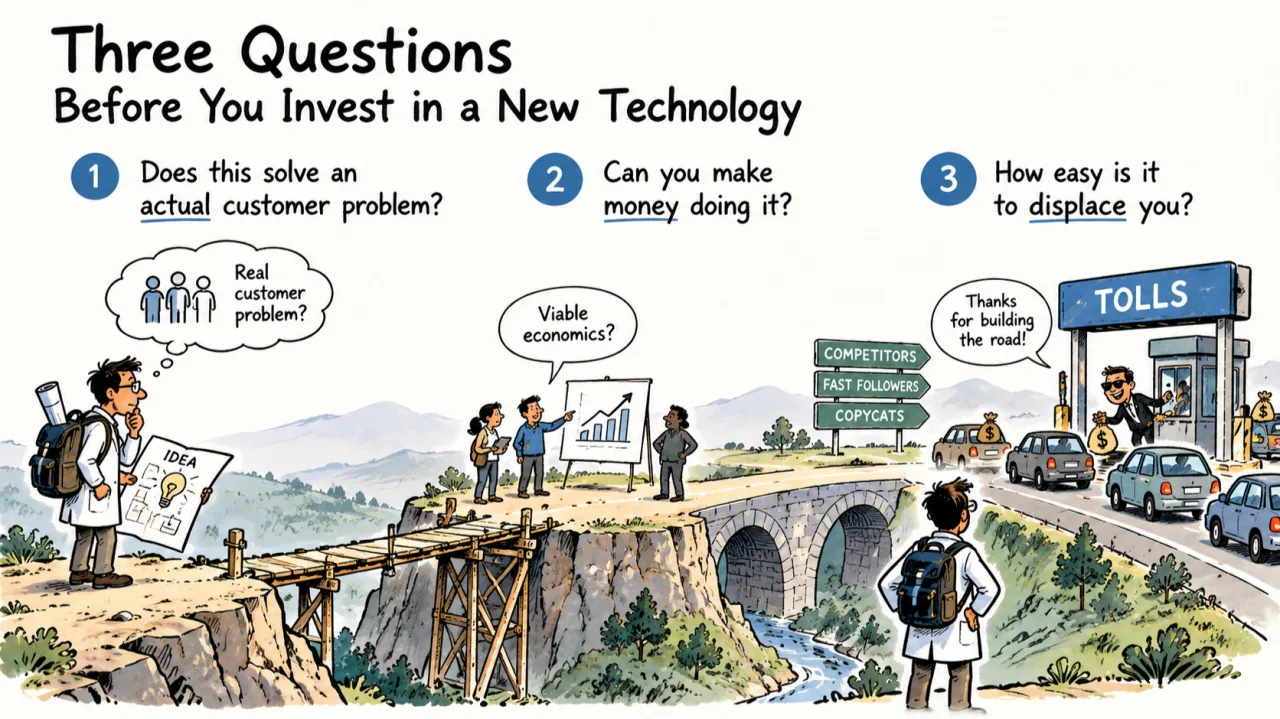
The rule set I've adopted consists of three questions that are remarkably simple but frequently missing from R&D decisions:
- Does this solve an actual customer problem?
- Can you make money doing it?
- How easily can competitors displace you once the solution is built?
The first question requires distinguishing between building a technology for a problem customers don't yet recognize and building a technology in the hope that someone will eventually find a problem for it to solve.
"If you build it, they will come" requires a certain leap of faith about adoption. But you should at least be able to identify a specific customer problem that your technology could solve. Otherwise, you're hoping that customers will figure this out for you, and your specifications and requirements may diverge dramatically from what they actually need.
The second question is equally critical. A common strategy is to ramp up as quickly as possible and expand your market. There's nothing wrong with that, provided there's a credible path to recovering the R&D investment and deployment costs, whether through scale or after the initial risks have been resolved. Costs associated with reliability, customer support, and technical sales are also frequently underestimated.
The third question is how easily competitors can displace you. With modern tools, competitors can often copy a solution surprisingly quickly unless you have strong regulatory, intellectual property, or other competitive protection. As the saying goes, "The early bird gets the worm, but the second mouse gets the cheese." If you invest the time and money to develop a solution only to have a competitor displace you before you recover your investment, you've created value for somebody else.
These are three questions I've shared with many people I've managed and mentored. They're worth asking both at the beginning of a project and during periodic reviews, to make sure the investments you're making still have a reasonable prospect of producing value for you.
Now, this may seem anti-innovation. How could anything get through the initial R&D stage if subjected to such a strict rule set?
As I'll discuss in the next article, this rule set isn't meant for initial exploratory and creative work. It becomes relevant when spending on an innovation begins to approach or exceed the budget you're willing to allocate to exploration alone, and the investment starts to resemble product R&D.
But for that, you'll have to read the next part.